Search-Focused Content Marketing
SEO Content for Small Business:
What Separates Content That Works From Content That Fills Space
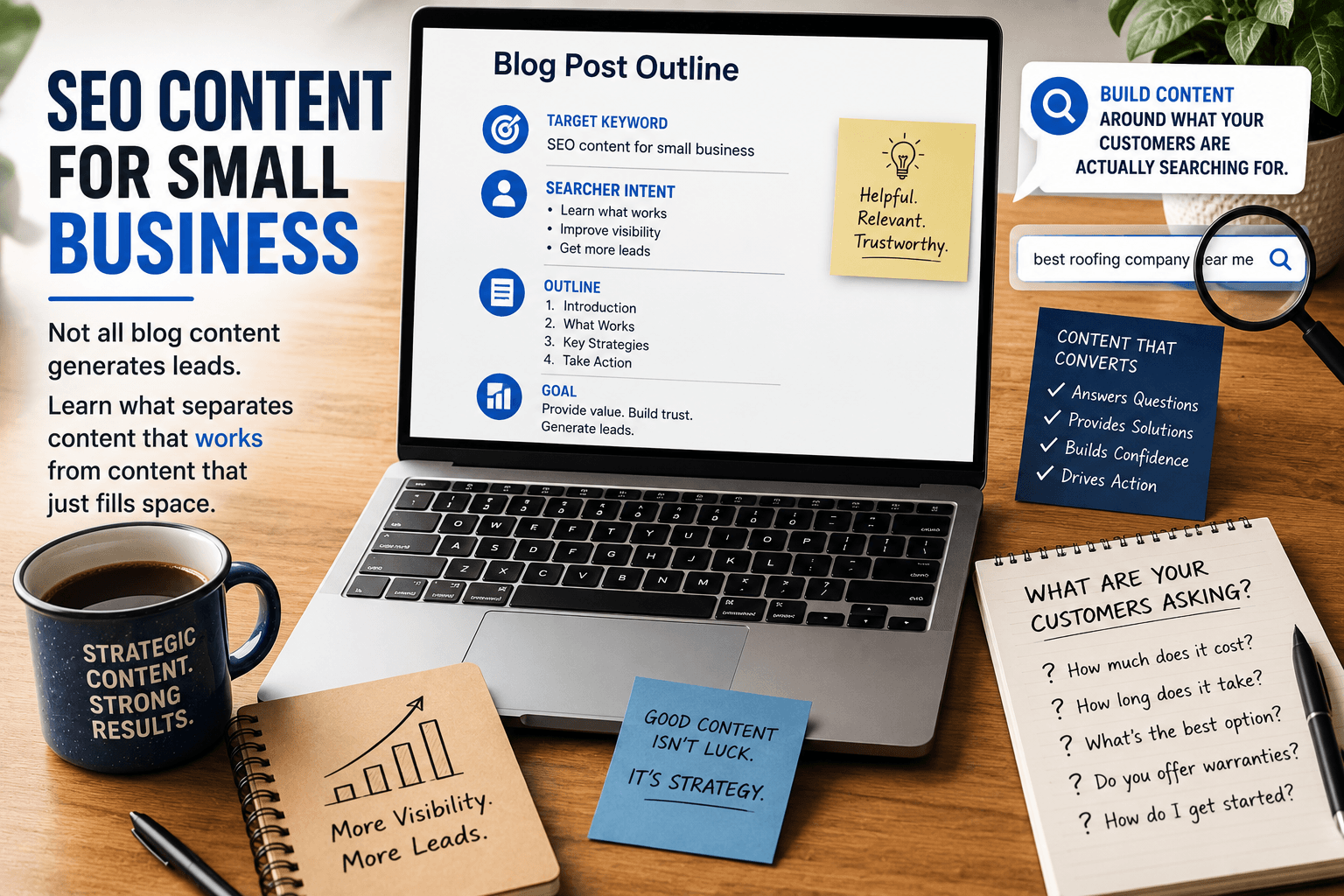
Not every blog post attracts visitors or generates leads.
Effective SEO content for small business starts with real
customer questions, clear search intent, useful answers, and
a strategy that connects each article to your services.
01
Targets Real Searches
Strong content begins with questions and topics customers
are already searching for.
02
Builds Trust
Useful answers demonstrate expertise before a prospect ever
contacts your business.
03
Supports Lead Generation
Strategic links and calls to action guide readers toward the
right product, service, or consultation.
Many small businesses have tried content marketing. They published a
handful of articles, stayed consistent for a few weeks or months, and
then stopped because the content did not appear to generate meaningful
traffic or leads.
That experience often leaves business owners believing content
marketing does not work for their industry.
In many cases, the problem is not content marketing itself. The
content was simply not built around the right topics, search intent,
website structure, or conversion strategy.
Effective SEO content for small business should help
the right customers discover your company, understand their options,
trust your expertise, and take the next step.
Publishing content and publishing strategic SEO content are not
the same thing.
One fills a blog archive. The other supports visibility, customer
education, and lead generation.
Why Most Small Business Content Fails
The most common mistake is writing about what the business wants to
announce instead of what potential customers are actively trying to
learn.
For example, an article titled “Our Company’s 20th Anniversary” may
be meaningful to the team and existing customers. However, it is
unlikely to match a common customer search.
Compare that with an article titled:
“How Much Does It Cost to Replace a Water Heater?”
That second topic answers a specific question from someone who may be
preparing to hire a plumber. It has a clearer search purpose and a
natural connection to a revenue-producing service.
Low Search Value
Our Company’s 20th Anniversary
- Focused primarily on the company
- Limited connection to customer problems
- Little ongoing search demand
- Weak path toward a service inquiry
Strong Search Value
How Much Does Water Heater Replacement Cost?
- Answers a real customer question
- Targets buying-related search intent
- Demonstrates service expertise
- Connects naturally to a quote request
This is the central difference between content that produces
opportunities and content that merely fills space.
Effective content begins with what the customer wants to know, not
with what the business feels like publishing.
What Small Business Customers Are Searching For
Customer searches vary by industry, but many fall into a small number
of predictable categories. Understanding these categories makes it
easier to create a useful content plan.
Cost Questions
Customers want to understand pricing, value, and whether a
product or service fits their budget.
Example: “How much does a small business website cost?”
Comparison Questions
These searches come from people evaluating different products,
services, materials, providers, or approaches.
Example: “WordPress vs. Shopify for a small business”
Problem-Solving Questions
Prospects search for explanations when something is broken,
confusing, inefficient, or not producing the expected result.
Example: “Why is my website getting traffic but no leads?”
Local Search Questions
Local customers often include a city, neighborhood, service
area, or “near me” phrase in their searches.
Example: “Web design company in Matteson, Illinois”
Process Questions
These topics explain what happens before, during, and after a
service or purchase.
Example: “What happens during a website redesign?”
Decision Questions
Prospects ask these questions when they are close to choosing
a solution or provider.
Example: “How do I choose a local SEO company?”
Content built around these topics can do two jobs at once. It gives
search engines a relevant page to display, and it helps potential
customers become more confident about contacting your business.
Search Intent Matters More Than Search Volume Alone
A topic can receive a large number of searches without being valuable
to your business.
The more important question is why the person is searching.
This is known as search intent.
Informational
The Searcher Wants to Learn
Educational articles, FAQs, explanations, and guides can
satisfy informational intent.
Commercial
The Searcher Is Comparing Options
Comparison articles, buyer guides, case studies, and
benefit-focused pages support commercial research.
Transactional
The Searcher Is Ready to Act
Service pages, product pages, pricing content, quote pages,
and booking pages support high-intent searches.
Local
The Searcher Needs a Nearby Provider
City pages, service-area content, local FAQs, reviews, and
Google Business Profile activity support local intent.
The best content strategy includes pages for different stages of the
customer journey. Educational content attracts attention. Comparison
content builds preference. Service and sales pages create the path to
conversion.
Helpful Content Comes First and Optimization Comes Second
Older SEO strategies often focused on repeating keywords as many times
as possible. The result was awkward content written for a search engine
instead of a customer.
Modern SEO content should read naturally and answer the question
thoroughly. The keyphrase provides direction, but usefulness should
guide the final article.
A practical process looks like this:
- Identify a real question or search opportunity.
- Determine what the searcher is trying to accomplish.
- Write the most useful and direct answer you can provide.
- Organize the page with clear headings and short sections.
- Add the focus keyphrase and related terms naturally.
- Link the article to relevant services and supporting resources.
- End with a logical next step for the reader.
It should never make the article harder to understand or less natural
to read.
What Properly Optimized SEO Content Includes
Optimization helps search engines understand the page and helps readers
scan it quickly.
01
A Clear SEO Title
The title should describe the article accurately and include
the primary topic naturally.
02
One Focused H1
The main heading should establish the topic and match the
reader’s expectations.
03
Logical H2 and H3 Headings
Subheadings divide the content into clear sections and make
long articles easier to navigate.
04
A Useful Meta Description
The description should summarize the page and give searchers a
clear reason to click.
05
Natural Keyphrase Usage
The primary keyphrase and related terms should appear where
they make sense, not where they feel forced.
06
Relevant Internal Links
Links should guide readers toward related articles, service
pages, case studies, and conversion pages.
07
Optimized Images
Images should use descriptive filenames, useful alt text, and
dimensions that do not slow down the page.
08
A Strong Call to Action
Every article should give the reader a relevant next step,
such as viewing a service or booking a consultation.
Not Sure What to Write About?
Start With What Your Customers Are Searching For
Book a free Website Visibility Review and we will discuss the
questions, services, and search opportunities that could support
your business.
Consistency Matters More Than Publishing Large Volumes
Publishing fifteen articles in one month and then remaining inactive
for six months rarely creates a strong long-term content system.
A realistic and repeatable publishing schedule is usually more useful
than a short burst that cannot be maintained.
For one business, consistency may mean one strong article each week.
For another, it may mean two well-researched articles each month,
supported by Google Business Profile posts and social media promotion.
The right schedule depends on:
- Your competition
- The current condition of your website
- The number of products or services you offer
- The cities and markets you want to reach
- The amount of quality content you can maintain
- Your available marketing budget and resources
Content marketing is a compounding process. Early articles build the
foundation. Later content expands the range of questions and searches
your website can address.
01
Publish Useful Content
Create a page that answers a real question.
02
Connect Related Pages
Add internal links to supporting content and services.
03
Expand Search Coverage
Address related questions, locations, and buying concerns.
04
Build Search Authority
Develop a connected library of useful information over time.
SEO Content Alone Is Not Enough
Even a strong article needs support to reach its full potential.
Content works best as one part of a broader system that includes
website structure, internal linking, local search activity, conversion
design, promotion, and measurement.
Internal Linking
Internal links help readers discover related information and
help search engines understand the relationship between pages.
Service Pages
Blog content should support clear service pages that explain
your offer and give qualified visitors a next step.
Google Business Profile
Local profile posts, reviews, services, and accurate information
support searches with local intent.
Social Promotion
Articles can be repurposed into posts, short videos, emails,
graphics, and customer follow-up resources.
Conversion Strategy
Calls to action, booking links, phone numbers, forms, and
persuasive service pages help convert traffic into inquiries.
Performance Tracking
Search impressions, traffic, calls, form submissions, and sales
help reveal which topics are producing business value.
How Internal Links Strengthen Small Business SEO Content
Internal links are links between pages on your own website. They are
essential because they prevent useful articles from becoming isolated.
For example, an article about the cost of replacing a water heater
could link to:
- A water-heater installation service page
- A financing or payment-options page
- A guide comparing tank and tankless systems
- A local city page for the customer’s service area
- A quote-request or appointment page
The article answers the immediate question, while the links help the
reader continue toward a hiring decision.
How SEO Content Generates Leads
Content does not generate leads simply because someone visits the page.
The page must attract the right person and guide that visitor toward
an appropriate action.
1
The Customer Searches
A prospect enters a question, problem, service, or local search.
2
Your Article Appears
The title and description match the question closely enough to
earn the click.
3
The Content Builds Trust
The reader receives a clear answer and sees evidence of your
expertise.
4
The Reader Takes Action
A relevant call to action leads to a service page, form, phone
call, purchase, or consultation.
This is why SEO content needs a conversion goal. An article about cost
should connect to an estimate. A comparison guide should connect to
the recommended solution. A local article should connect to the
appropriate service-area page.
How GBN Creates SEO Content for Small Businesses
SEO content creation is one of the ten steps in the
GBN Search Authority System™.
The process begins with research so each article is based on a real
search opportunity, customer question, service need, or buying concern.
We then connect content creation with:
- Keyword and customer-question research
- Search-intent analysis
- SEO titles and meta descriptions
- Clear heading structures
- Internal links
- Service-page support
- Google Business Profile content
- Social media repurposing
- Calls to action
- Ongoing measurement and improvement
This helps ensure the article does not simply get published and
forgotten. It becomes part of a connected search visibility and lead
generation system.
Review the complete process on the
GBN Content Visibility System page
.
Common Small Business Blogging Mistakes
×Writing without keyword or customer research
×Choosing topics with no connection to services
×Publishing thin articles that do not answer the question
×Stuffing keywords into unnatural sentences
×Ignoring internal links
×Publishing without a call to action
×Failing to promote or repurpose the article
×Expecting immediate results from one post
Frequently Asked Questions
SEO Content for Small Business FAQs
What is SEO content for small business?
SEO content for small business is website content created to
answer relevant customer searches, demonstrate expertise,
support important services, and attract qualified visitors from
Google and other search platforms.
Does blogging help small business SEO?
Blogging can support SEO when articles target relevant searches,
answer real questions, link to important service pages, and
become part of a consistent content strategy.
How often should a small business publish blog content?
The right schedule depends on the industry, competition,
resources, and goals. Many small businesses can benefit from
publishing two to four strong articles each month if quality
can be maintained.
How long does SEO content take to work?
The timeline varies based on competition, website authority,
search demand, content quality, internal links, backlinks, and
publishing consistency. SEO content usually produces stronger
results through ongoing work rather than one isolated article.
Should every blog post target a keyword?
Most search-focused articles should target a clear topic or
keyphrase. The phrase should guide the content naturally rather
than being repeated excessively.
What blog topics generate leads?
Topics connected to costs, comparisons, common problems,
buying decisions, local services, timelines, benefits, and
customer objections often create strong lead-generation
opportunities.
Can GBN Web Development create and publish the content?
Yes. GBN Web Development can manage research, content planning,
writing, SEO optimization, internal linking, publishing,
Google Business Profile content, social promotion, and ongoing
strategy through the GBN Search Authority System™.
Build Content Around Real Customer Demand
Find Out What Your Customers Are Searching For
Book a free 15-minute Website Visibility Review with GBN Web
Development. We will discuss your services, customers, current
website content, and the search topics most likely to support your
business goals.
Turn useful content into a connected growth system with our digital marketing services for small businesses.