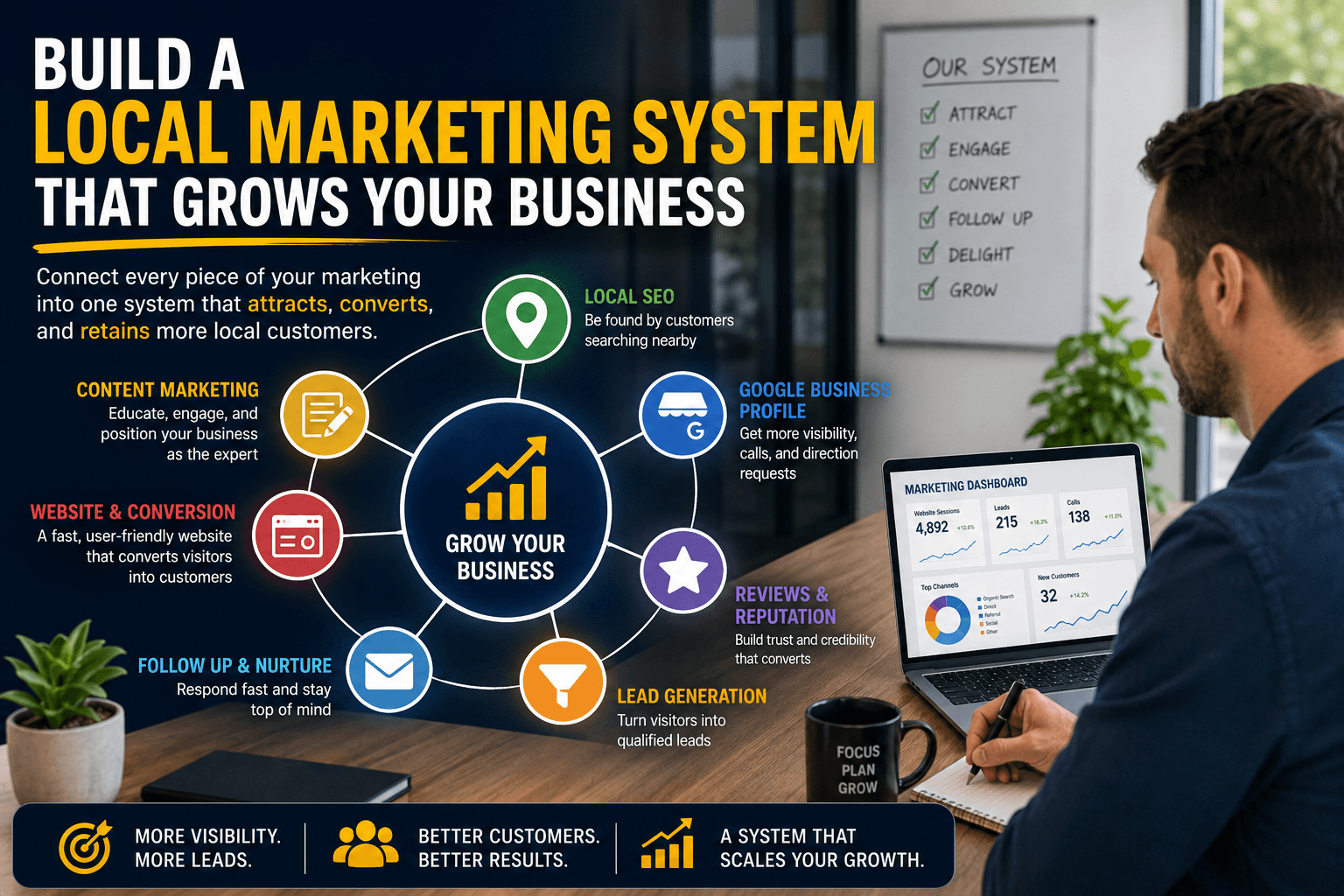
Build a Local Marketing System That Grows Your Business
Bring your website, Local SEO, Google Business Profile, customer reviews, content, calls to action, follow-up, and lead tracking together into one repeatable system for attracting local customers and producing long-term growth.
What Is a Local Marketing System?
A local marketing system is a repeatable process that helps a business attract nearby customers, build trust, generate qualified leads, convert those leads into paying customers, and measure the results.
It combines a conversion-focused website, Local SEO, Google Business Profile optimization, service and location pages, customer reviews, educational content, social distribution, clear calls to action, fast follow-up, and lead tracking.
The goal is not to depend on one tactic. The goal is to create a connected system in which every marketing asset supports the same customer journey.
Stop Treating Marketing Like a Collection of Unrelated Tasks
Most small businesses do not have a lack of marketing ideas. They have a lack of structure.
They may have a website, a Google Business Profile, a Facebook page, a few reviews, several old blog posts, and an occasional advertising campaign. However, those assets often operate separately.
The website may promote one service while social media discusses another. The Google Business Profile may be outdated. Blog posts may not link to service pages. Calls may not be tracked. Form submissions may receive inconsistent follow-up.
Each activity may have value, but disconnected marketing creates inconsistent results. The business spends time and money without building momentum.
A system creates alignment. It identifies the services you want to sell, the customers you want to reach, the locations you want to serve, the questions those customers ask, the proof they need, and the actions you want them to take.
Every page, article, review, post, call to action, and follow-up message then supports that strategy.
Five Stages That Turn Visibility Into Business Growth
Sustainable growth requires more than appearing in search. Every stage must guide the customer toward the next decision.
A Single Marketing Activity Cannot Carry the Entire Business
Strong results emerge when several coordinated assets support one another.
Marketing Compounds
A useful article can attract search traffic, support a service page, become a social post, answer a sales question, and strengthen your authority.
Customers Receive Consistent Messaging
Your website, Google profile, content, reviews, and sales process communicate the same services, value, and next step.
Weaknesses Become Easier to Find
Tracking reveals whether the problem is visibility, trust, conversion, response time, qualification, or sales follow-up.
Growth Becomes Repeatable
The business can repeat the same process for additional services, locations, customer questions, and campaigns.
Marketing Becomes an Asset
Service pages, articles, reviews, videos, and optimized profiles can continue producing value after publication.
Decisions Improve
The business can invest more in services, pages, and locations that produce qualified leads and profitable jobs.
Ten Pillars of a Local Marketing System
These pillars bring the entire GBN Local Business Growth Blueprint™ together.
Define Your Most Valuable Services
Begin with the services the business most wants to sell. Consider profitability, demand, capacity, customer value, seasonality, and competitive advantage.
Avoid building a strategy around every possible service at once. Choose several priority offers and make them clear throughout the website and marketing system.
- Which services produce the strongest revenue?
- Which services attract your best customers?
- Which services can the business deliver consistently?
- Which services have clear local search demand?
Identify Your Ideal Local Customers
Define who needs the service, where those customers live or operate, what problems they are trying to solve, and what influences their hiring decision.
A residential homeowner, commercial property manager, medical practice, restaurant owner, and nonprofit organization may all evaluate providers differently.
Your messaging should reflect the customer’s situation, concerns, desired outcome, and decision process.
Build a Conversion-Focused Website
Your website should immediately explain what the business provides, who it serves, where it operates, and what the visitor should do next.
Strong websites reduce friction through clear navigation, fast mobile performance, visible contact information, focused service pages, relevant proof, and simple forms.
- Clear homepage positioning
- Dedicated service pages
- Service-area information
- Customer reviews and case studies
- Visible calls to action
- Mobile-friendly call and form options
Improve Local Search Visibility
Local SEO helps search engines understand what the business does, where it operates, and which searches are relevant.
Optimize page titles, headings, service descriptions, internal links, location signals, image alt text, and structured data. Build pages around real customer intent rather than repeating city names without useful content.
The objective is to connect your priority services with nearby customers actively searching for those solutions.
Strengthen Your Google Business Profile
Keep the profile accurate, complete, active, and aligned with the website.
- Select accurate primary and secondary categories.
- List important services and products.
- Maintain correct hours and contact information.
- Add current project, team, and location photos.
- Publish useful business updates.
- Respond professionally to customer reviews.
- Use appropriate appointment and website links.
A strong profile can generate calls, website visits, directions, appointments, and customer confidence.
Find the Gaps Preventing Your Marketing From Producing More Customers
GBN Web Development can review your website, Local SEO, Google Business Profile, service pages, content, reviews, calls to action, and lead process.
Publish Content That Supports Customer Decisions
Content should answer the questions customers ask before contacting, hiring, or purchasing.
Create articles, guides, FAQs, videos, and social posts around:
- Costs and pricing factors
- Timelines and processes
- Common problems and warning signs
- Repair versus replacement
- Service comparisons
- How to choose a provider
- What customers should expect
- Mistakes to avoid
Every piece of content should support an important service, customer question, or next action.
Build Trust Through Reviews and Proof
Customers need evidence that your company can deliver the promised result.
Use detailed reviews, project photos, before-and-after examples, case studies, certifications, years of experience, guarantees, partnerships, and clear processes.
Place relevant proof near the claims it supports. Do not isolate every review or project example on a separate page.
Distribute Every Important Message Across Multiple Channels
One strong topic can support several marketing assets. A blog article can become:
- A Google Business Profile post
- A Facebook post
- An Instagram caption
- A LinkedIn post
- A short-form video script
- An email newsletter section
- A sales follow-up resource
Repurposing improves consistency without requiring the business to invent a completely new message every day.
Convert and Follow Up With Qualified Leads
Make the next step easy, then respond while the customer is still interested.
Use clear call buttons, short forms, scheduling links, quote requests, and confirmation messages. Establish a process for responding, qualifying, scheduling, estimating, and following up.
Marketing performance is weakened when qualified leads receive slow or inconsistent responses.
Measure Revenue and Improve the System
Track the full journey from visibility to revenue.
- Search impressions
- Map and profile visibility
- Service-page traffic
- Calls and form submissions
- Qualified leads
- Appointments and estimates
- Jobs won
- Revenue by service and source
Improve the pages, services, locations, and campaigns that produce strong results. Revise or remove tactics that generate activity without business value.
The Difference Is Coordination
Disconnected Marketing
- Publishes content without a clear service strategy
- Uses social media without connecting posts to website pages
- Updates Google Business Profile only occasionally
- Creates one general page for every service
- Collects reviews but does not use them throughout the website
- Tracks website traffic but not qualified leads
- Responds to inquiries inconsistently
- Changes tactics whenever results slow down
- Depends heavily on paid traffic and referrals
Connected Growth System
- Prioritizes profitable services and ideal customers
- Builds dedicated pages for important services
- Targets relevant searches and service areas
- Publishes content that supports customer decisions
- Distributes each topic across multiple channels
- Uses reviews and proof near important claims
- Guides visitors toward one clear next step
- Tracks leads, estimates, customers, and revenue
- Improves the system consistently over time
A Simple Four-Week Local Marketing Cycle
Consistency becomes easier when the work follows a repeatable monthly schedule.
Week 1: Research and Plan
- Review current leads and customer questions.
- Choose one priority service or topic.
- Identify relevant keywords and search intent.
- Select internal links and the primary call to action.
- Confirm the target service area.
Week 2: Create and Optimize
- Write or improve the primary page or article.
- Add customer-focused headings and FAQs.
- Include reviews, proof, and relevant images.
- Optimize the page title, description, and internal links.
- Add a clear contact or booking action.
Week 3: Distribute
- Publish the primary website content.
- Create a Google Business Profile post.
- Create social media versions.
- Develop a short video or image.
- Share the resource with leads or customers when relevant.
Week 4: Measure and Improve
- Review page visibility and engagement.
- Track calls, forms, and appointments.
- Identify qualified leads and jobs won.
- Improve weak headlines or calls to action.
- Select the next monthly priority.
How to Start Building the System
You do not need to rebuild everything at once. Start with the assets closest to revenue and expand deliberately.
Days 1–30: Fix the Foundation
- Choose three to five priority services.
- Clarify the ideal customer and service area.
- Improve the homepage message and primary call to action.
- Make phone numbers and forms easy to find.
- Complete and update the Google Business Profile.
- Repair technical website issues that block conversion.
- Install lead and conversion tracking.
Days 31–60: Build Search and Trust Assets
- Create or improve priority service pages.
- Add relevant service-area information.
- Collect and publish stronger reviews.
- Add project photos, case studies, and credentials.
- Create FAQs based on real customer questions.
- Improve internal links between related pages.
- Publish at least one strong educational article.
Days 61–90: Create the Publishing and Measurement Rhythm
- Establish a monthly content calendar.
- Repurpose website content for social and Google posts.
- Track leads by service and source.
- Review response time and sales follow-up.
- Identify pages producing the strongest opportunities.
- Improve weak conversion paths.
- Plan the next 90 days based on actual results.
How a Local Service Company Turns Scattered Marketing Into a System
Consider a local heating and cooling company that relies on referrals, seasonal advertising, and occasional social media posts. The company has a website and Google Business Profile, but both are outdated.
The company begins by choosing three priority services: furnace repair, air-conditioning repair, and maintenance plans. It creates a dedicated page for each service and adds relevant service-area information.
Each page explains common problems, the service process, expected timelines, reasons to choose the company, customer reviews, and a clear call to schedule service.
The company updates its Google Business Profile, adds recent project photos, lists services, responds to reviews, and publishes regular updates.
Each month, the company publishes one educational article based on a real customer question. The article links to an appropriate service page and is repurposed into Google, Facebook, Instagram, and email content.
Calls and forms are tracked by page and source. The company also measures appointments, estimates, maintenance plans sold, and revenue produced.
The result is not one isolated marketing campaign. It is a connected process that attracts customers, builds trust, generates inquiries, supports sales, and improves over time.
Measure the Entire Customer Journey
Review metrics that connect marketing activity with real business outcomes.
| Stage | What to Track | Question to Answer |
|---|---|---|
| Visibility | Search impressions, map visibility, profile views, rankings, page impressions, and branded searches. | Can qualified local customers find the business? |
| Engagement | Service-page visits, content engagement, profile actions, call-button clicks, and scheduling clicks. | Are customers interacting with commercially valuable assets? |
| Trust | Review quantity, review quality, profile completeness, project views, case-study engagement, and return visits. | Does the business provide enough proof to reduce uncertainty? |
| Leads | Calls, forms, appointments, quote requests, emails, chats, and direction requests. | Is visibility turning into customer conversations? |
| Lead Quality | Service fit, location fit, budget fit, urgency, decision-maker status, and project value. | Is the system attracting the right opportunities? |
| Sales | Appointments booked, estimates issued, proposals sent, win rate, average sale value, and sales cycle. | Is the lead process converting opportunities into customers? |
| Revenue | Revenue by service, location, page, campaign, and marketing source. | Which assets and activities produce profitable growth? |
| Retention | Repeat customers, maintenance agreements, referrals, reviews, email engagement, and lifetime value. | Is the system creating long-term customer value? |
Does Your Local Marketing Work as One Connected System?
- We know which services we most want to sell.
- We have clearly defined our ideal local customers.
- Our homepage explains what we do, who we serve, and where.
- Every priority service has a dedicated page.
- Our phone number and primary call to action are easy to find.
- Our website works well on mobile devices.
- Our Google Business Profile is complete and current.
- We add recent photos and updates consistently.
- We request and respond to customer reviews.
- Relevant reviews appear on important website pages.
- We publish content based on real customer questions.
- Our articles link to relevant services and next steps.
- We repurpose important content across multiple channels.
- New inquiries receive fast and professional responses.
- We track calls, forms, appointments, and estimates.
- We know which leads become paying customers.
- We measure revenue by service and marketing source.
- We review and improve the system every month.
Build a Clear Local Marketing Plan Around Your Business Goals
GBN Web Development helps small businesses connect web design, Local SEO, Google Business Profile optimization, content, customer reviews, social media, conversion, and lead tracking.
Building a Local Marketing System
What is the first step in building a local marketing system?
Start by identifying the services the business most wants to sell, the customers it wants to reach, the locations it wants to serve, and the action it wants prospective customers to take.
Does a local marketing system require paid advertising?
No. Paid advertising can support the system, but the foundation can include Local SEO, Google Business Profile optimization, service pages, reviews, content, referrals, email, and conversion-focused web design.
How long does it take to build a local marketing system?
The foundation can often be improved within the first 30 to 90 days. Search visibility, content authority, reviews, and organic lead generation usually strengthen over time as the business publishes, measures, and improves consistently.
How often should a local business publish content?
The right schedule is one the business can maintain. One or two strong articles per month can be valuable when each article supports an important service, answers a real customer question, and is distributed across several channels.
Which local marketing metrics matter most?
Track visibility, calls, forms, appointments, qualified leads, estimates, jobs won, average sale value, and revenue by service and source. Traffic and rankings are useful, but they should connect to business outcomes.
Can a small business manage this system internally?
Yes, when the responsibilities, schedule, tools, and approval process are clearly defined. Some businesses manage parts internally and use a specialist for strategy, web development, SEO, content, automation, or reporting.
How does content support Local SEO?
Content helps search engines and customers understand the business’s expertise, services, and relevance. Articles can answer customer questions, support service pages, attract long-tail searches, create internal links, and provide material for social and Google posts.
Can GBN Web Development build this system for my business?
Yes. GBN Web Development helps small businesses with conversion-focused websites, Local SEO, Google Business Profiles, service and location pages, blogging, content distribution, lead generation, and website optimization.
Put the Local Growth System Into Action
You Now Have the Complete Local Business Growth Framework
The GBN Local Business Growth Blueprint™ was designed to show how local visibility, trust, website conversion, content, follow-up, and measurement work together.
The complete system follows a clear progression:
- Attract customers without depending entirely on advertising.
- Turn the website into a stronger salesperson.
- Generate more calls from people ready to hire.
- Stop losing customers to better-positioned competitors.
- Turn online searches into paying customers.
- Keep the phone ringing with qualified local leads.
- Generate more quote requests from the website.
- Grow revenue through consistent local visibility.
- Win more local jobs without chasing customers.
- Build one connected marketing system that grows the business.
Turn the Blueprint Into a Marketing System Built for Your Business
Get expert feedback on your website, Local SEO, Google Business Profile, content strategy, calls to action, lead generation, and the practical next steps required to grow your local visibility.
Put these steps to work through a connected digital marketing strategy designed for small-business growth.