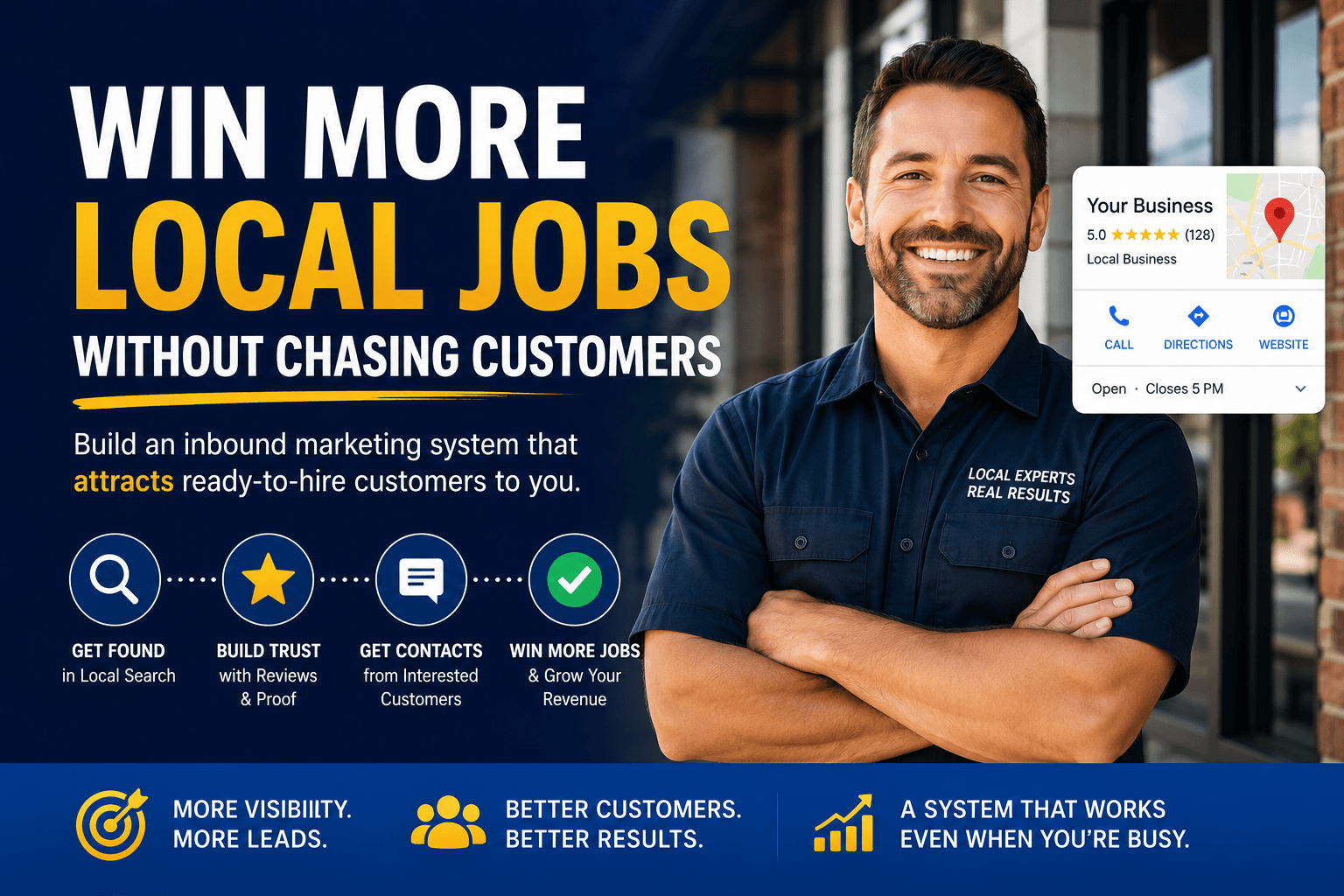
Win More Local Jobs Without Chasing Customers
Learn how to build an inbound local marketing system that helps nearby customers discover your business, trust your expertise, request a quote, and hire you without depending on cold outreach, constant discounts, or expensive lead-selling platforms.
How Can a Local Business Win More Jobs Without Chasing Customers?
A local business can win more jobs without constantly chasing customers by building an inbound marketing system that appears when nearby people are actively searching for its services. The system should combine Local SEO, Google Business Profile optimization, dedicated service pages, customer reviews, educational content, clear calls to action, fast follow-up, and lead tracking.
Instead of repeatedly interrupting strangers, the business attracts prospects who already recognize a need, understand the service, and are closer to making a purchasing decision.
Chasing Customers Is Expensive, Exhausting, and Difficult to Scale
Many local businesses rely on a reactive marketing cycle. When work slows down, they scramble to find new customers.
They send messages to old contacts, purchase shared leads, run short-term advertisements, offer discounts, post repeatedly on social media, or ask friends and customers for referrals.
These activities may occasionally produce business, but they do not necessarily build a reliable customer acquisition system. Once the campaign ends or the business owner becomes busy, the flow of opportunities slows down again.
Inbound marketing creates a different relationship. Instead of starting every sales conversation with a stranger, your business becomes visible while the customer is already researching a problem, comparing options, or searching for a provider.
The customer may find your Google Business Profile, service page, location page, customer review, educational article, social post, video, or AI-generated recommendation. Each useful encounter moves the customer closer to contacting your business.
Four Conditions That Help Customers Come to You
Inbound demand grows when customers can easily find, understand, trust, and contact your business.
Be Discoverable
Your business must appear when nearby customers search for your services, problems, products, or industry.
Be Relevant
Your page must closely match the service, location, and customer need that produced the search.
Be Trustworthy
Reviews, expertise, project examples, guarantees, and clear information must reduce the customer’s uncertainty.
Be Easy to Hire
Calls, forms, scheduling links, pricing guidance, and next steps must be simple and visible.
How a Local Search Becomes a Local Job
Your marketing system should guide the customer through each stage without unnecessary confusion or friction.
Eight Steps to Win More Local Jobs
Each step strengthens your ability to attract customers who are already looking for a solution.
Target Searches That Show Real Buying Intent
Not every search has the same business value. Some people are only gathering general information. Others are actively looking for a provider, price, appointment, estimate, or immediate solution.
Focus your strongest service pages and local content on searches that indicate a customer may soon hire someone.
- Service plus city searches
- “Near me” searches
- Emergency or urgent service searches
- Repair, replacement, installation, or consultation searches
- Cost and estimate-related searches
- Provider comparison and review searches
A smaller number of high-intent visitors can produce more revenue than a large audience with little purchasing intent.
Create a Strong Page for Every Important Service
A customer searching for one specific service should not land on a vague page that lists everything your company offers in a few sentences.
Each major service page should clearly explain:
- The customer problem or need
- The service you provide
- Who the service is for
- Your process
- Expected outcomes
- Service areas
- Common questions
- Reasons to choose your company
- The next step
Focused pages make your business easier for customers, Google, and AI-powered search systems to understand.
Make Your Google Business Profile a Lead Source
Many customers may contact your business directly from Google Search or Maps without first visiting your website.
Your Google Business Profile should clearly communicate your services, service areas, hours, contact information, customer reviews, photos, products, offers, and appointment options.
Add new project photos, publish useful updates, answer questions, respond to reviews, and keep every detail accurate. An active profile can help customers feel more confident that the business is legitimate and responsive.
Use Reviews and Proof to Pre-Sell Your Business
Customers often compare several companies before contacting one. Reviews, project photos, case studies, certifications, guarantees, and experience can answer important questions before the sales conversation begins.
Place relevant proof near the service or claim it supports. A review about emergency response belongs on an emergency service page. A case study about increasing sales belongs near a marketing or conversion service.
The goal is not to claim that your company is trustworthy. The goal is to provide enough evidence for the customer to reach that conclusion.
Find Out Why Local Customers Are Not Contacting Your Business
GBN Web Development can review your website, service pages, Google Business Profile, Local SEO, content, trust signals, calls to action, and customer journey.
Answer Questions Before the Customer Calls
Customers hesitate when important questions remain unanswered. Useful content reduces uncertainty and helps qualified prospects move closer to a decision.
Publish content that explains:
- Typical costs and pricing factors
- Project or service timelines
- Warning signs and common problems
- Service differences and options
- What customers should expect
- How to prepare for service
- How to choose a provider
- Mistakes to avoid
Educational content does not replace sales. It improves the quality of the sales conversation by helping customers arrive more informed.
Make the Next Step Obvious and Easy
A customer should not have to search for your phone number, guess how to request an estimate, or complete a long form before understanding what happens next.
Use one clear primary action throughout each page. That action might be:
- Call now
- Request a quote
- Schedule a consultation
- Book an appointment
- Request an inspection
- Check availability
Place the action near the top of the page, after major service explanations, beside strong proof, and at the bottom of the page.
Respond While the Customer Is Still Ready to Act
Marketing does not end when a form is submitted. Slow or inconsistent follow-up can waste the opportunity your website worked to create.
Develop a simple response process:
- Confirm that the request was received.
- Respond as quickly as practical.
- Ask the questions needed to qualify the opportunity.
- Explain the next step clearly.
- Schedule the estimate, call, or appointment.
- Follow up when a qualified prospect becomes unresponsive.
Fast, professional communication can become an important competitive advantage.
Track Which Leads Become Profitable Jobs
A successful inbound system should be measured by more than traffic, rankings, clicks, or form submissions.
Track which pages, search terms, service areas, content, and marketing sources produce qualified leads and paying customers.
Use that information to strengthen high-performing pages, improve weak conversion paths, remove low-value targeting, and invest more heavily in services that produce profitable jobs.
Two Very Different Ways to Generate Local Jobs
Customer-Chasing Model
- Depends heavily on cold outreach
- Purchases shared leads from third-party platforms
- Runs promotions only when work becomes slow
- Competes primarily through price and discounts
- Starts each sales conversation with little trust
- Stops marketing when the schedule becomes busy
- Produces inconsistent monthly demand
- Creates pressure to accept poor-fit jobs
Inbound Customer Model
- Appears when customers actively search
- Builds owned website and content assets
- Uses reviews and proof to establish trust
- Targets services and locations strategically
- Educates customers before the first conversation
- Maintains marketing during busy periods
- Measures qualified leads and closed jobs
- Creates more opportunities to choose better-fit work
How a Contractor Can Generate Jobs Without Buying Shared Leads
Consider a local contractor who receives most new opportunities from referrals and a lead-selling platform. The contractor pays for leads that are also sent to several competitors, responds quickly, and frequently competes against the lowest price.
The company begins developing an inbound system. It creates dedicated pages for its highest-value services, adds city and service-area information, improves its Google Business Profile, and requests detailed reviews after completed jobs.
The contractor publishes articles that explain project costs, common warning signs, repair versus replacement, timelines, and how to choose a qualified provider. Each article links to an appropriate service page and quote request form.
Project photos, customer reviews, warranties, experience, and process information are added throughout the website. Calls and form submissions are tracked by page and service.
The contractor may still use advertising or referral platforms, but those channels are no longer the only source of opportunities. More prospects begin finding the business directly while actively searching for help.
Those prospects are often easier to qualify because they have already reviewed the contractor’s services, work, reputation, and process.
Why Local Businesses Still Have to Chase Work
Weak Search Visibility
The business does not appear for important services, locations, or high-intent customer searches.
Generic Service Pages
One short page attempts to describe every service without answering specific customer questions.
Insufficient Trust
The website lacks strong reviews, project examples, credentials, guarantees, or useful proof.
Hidden Calls to Action
Customers cannot quickly find the phone number, quote form, scheduling link, or next step.
Slow Follow-Up
Qualified opportunities are lost because responses are delayed, unclear, or inconsistent.
No Lead Attribution
The business does not know which pages, searches, or marketing activities produce profitable jobs.
Build a Website and Marketing System That Brings Customers to You
GBN Web Development helps small businesses improve Local SEO, Google Business Profile visibility, service pages, content, customer trust, calls to action, lead tracking, and website conversion.
Is Your Business Built to Attract Local Customers?
Use this checklist to identify gaps in your inbound marketing and sales process.
- Identify your highest-value services.
- Target searches that show purchasing intent.
- Create a dedicated page for every major service.
- Explain who each service is for.
- Add relevant service-area information.
- Complete and update your Google Business Profile.
- Publish recent project and team photos.
- Request detailed customer reviews consistently.
- Place relevant reviews on service pages.
- Answer cost, process, and timeline questions.
- Use clear mobile-friendly call buttons.
- Keep quote forms short and easy to complete.
- Explain what happens after a customer contacts you.
- Respond quickly to qualified opportunities.
- Track leads by service, source, and location.
- Measure estimates, jobs won, and revenue produced.
Metrics That Show Whether Your System Is Producing Jobs
The objective is not simply to generate more activity. It is to produce more qualified and profitable opportunities.
| Metric | What It Measures | Why It Matters |
|---|---|---|
| High-Intent Search Visibility | How often your business appears for searches connected to immediate customer needs. | Shows whether qualified prospects can discover your services. |
| Service-Page Visits | Traffic to the pages representing your most important offers. | Indicates whether customers are reaching commercially valuable content. |
| Calls and Quote Requests | Direct customer inquiries generated through your website and profiles. | Connects visibility with lead-generation activity. |
| Qualified Lead Rate | The percentage of inquiries that match your services, location, budget, and customer criteria. | Shows whether your targeting attracts the right opportunities. |
| Response Time | How quickly your business responds to a new inquiry. | Faster responses can improve appointment and estimate booking rates. |
| Estimate Rate | The percentage of qualified leads that advance to an estimate, proposal, or consultation. | Measures the effectiveness of qualification and follow-up. |
| Job-Win Rate | The percentage of estimates or proposals that become paying jobs. | Connects lead generation with sales performance. |
| Revenue by Source | Revenue connected to Google, Maps, service pages, content, referrals, or advertisements. | Identifies which marketing assets produce the greatest business value. |
Turn Individual Marketing Tactics Into One Growth System
Local SEO, content, reviews, service pages, Google Business Profile activity, calls to action, and follow-up should not operate as disconnected activities.
The strongest results come when every element supports the same customer journey and business priorities.
Part 10 will bring the complete Blueprint together into a repeatable local marketing system designed to support long-term business growth.
From Inbound Leads to Predictable Growth
- Choose priority services and locations.
- Build strong service and location pages.
- Increase Google and Maps visibility.
- Publish useful content consistently.
- Strengthen reviews and customer proof.
- Convert visitors into qualified inquiries.
- Respond and follow up professionally.
- Measure which leads become profitable jobs.
- Improve the system every month.
Strengthen Your Inbound Local Marketing System
Winning More Local Jobs Without Chasing Customers
What does it mean to win jobs without chasing customers?
It means building an inbound marketing system that helps customers discover and contact your business while they are already searching for a solution. The business relies less on cold outreach, constant discounts, purchased leads, and last-minute promotions.
What is inbound local marketing?
Inbound local marketing uses Local SEO, Google Business Profile optimization, service pages, location pages, reviews, educational content, and conversion-focused web design to attract nearby customers who are actively researching or searching for services.
Is Local SEO enough to generate more jobs?
Local SEO can improve discovery, but visibility alone does not guarantee customers. The website must also communicate value, build trust, provide relevant proof, make contact easy, and support fast professional follow-up.
How do service pages help generate local leads?
Dedicated service pages help customers and search engines understand exactly what the business provides. They allow the company to answer service-specific questions, target relevant searches, display related reviews, and present a clear next step.
Why are customer reviews important for inbound leads?
Reviews help prospective customers evaluate quality, reliability, communication, professionalism, and results before contacting the business. Strong reviews can reduce uncertainty and improve lead quality.
How quickly should a business respond to a website lead?
A business should respond as quickly as reasonably possible while the customer is still actively considering the service. An immediate confirmation and prompt personal response can improve the likelihood of scheduling the next step.
Should a business stop using paid advertising or referral platforms?
Not necessarily. Paid advertising and referral platforms may still support growth. The objective is to avoid depending entirely on rented traffic or shared leads by also developing owned website, content, review, and search assets.
Can GBN Web Development build an inbound lead system for my business?
Yes. GBN Web Development helps small businesses improve web design, Local SEO, Google Business Profiles, service pages, location content, blogging, calls to action, internal links, lead tracking, and website conversion.
Stop Chasing Every Lead and Build a System That Brings Customers to You
Build a stronger local search presence, more persuasive website, clearer customer journey, and repeatable inbound lead system.
Continue to the Final Step
Part 8: Grow Your Revenue With Consistent Local Visibility
Learn how consistent Local SEO, content, reviews, and Google Business Profile activity can create more predictable revenue opportunities.
Read Part 8Part 10: Build a Local Marketing System That Grows Your Business
Bring every stage of the Blueprint together into one repeatable system for visibility, leads, customers, and long-term growth.
Continue to Part 10Win more nearby opportunities with local SEO that attracts ready-to-buy customers.